
Our family of four averaged seven to eight miles of walking a day in Japan. I know because my phone kept telling me, usually around the time one of our kids started negotiating for a taxi.
Here’s how we actually got around — trains, cabs, Ubers, and a whole lot of sidewalk — and the handful of things I wish someone had explained before our first turnstile.
The Short Answer
We used everything. A pre-booked cab from the airport, Suica cards on our iPhones for the trains, paper tickets from the station machines for our kids, and an Uber or a taxi whenever the day had already extracted its seven miles from two elementary schoolers.
The train system looks intimidating from the outside; after one or two rides it’s genuinely intuitive. But the smartest move we made was not forcing any single mode of transportation to do everything.
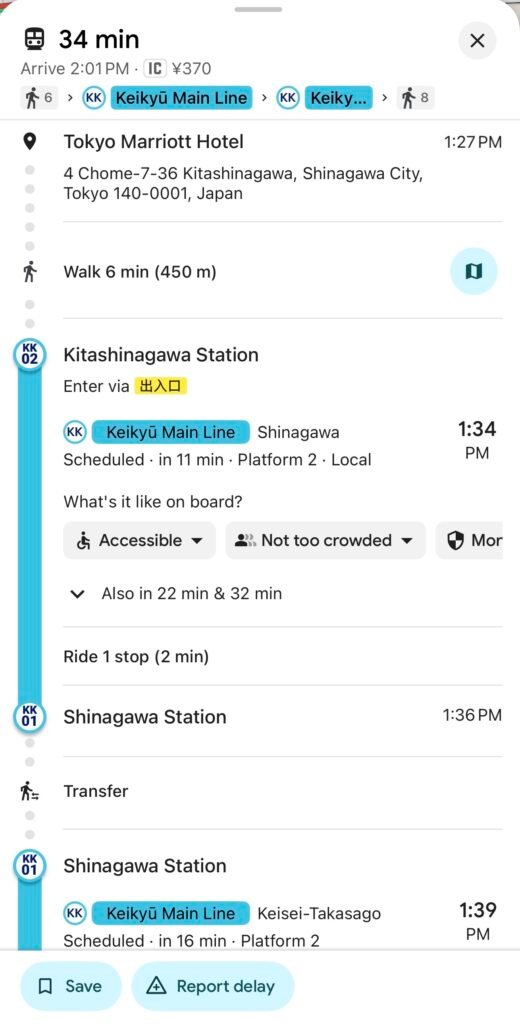
One thing deserves almost as much credit as Suica: Google Maps. It told us exactly which train to board, which platform to use, where to transfer, and even which station exit put us closest to our destination. I expected to spend half the trip staring at rail maps. Instead, we mostly followed Google Maps one step at a time, and it was remarkably accurate.
From the Airport: We Took a Cab, and I’d Do It Again
Every Japan guide will tell you to take the train from Narita into Tokyo. The train is cheaper. The guides are right about that.
Here’s what the guides aren’t accounting for: a family of four coming off a 13-hour flight from Houston, multiple suitcases, backpacks, two kids, and zero experience with the Japanese rail system. Dragging all of that through train transfers as your very first activity in a foreign country is nobody’s idea of a vacation.
We booked a cab online before we landed. Narita to our hotel in Tokyo ran about $120. Not cheap — but the driver was waiting, the luggage disappeared into the trunk, and our first hour in Japan was spent looking out a window instead of deciphering a rail map with a jet-lagged ten-year-old asking how much longer. For first-timers with kids and luggage, it was worth every dollar. Travelers packing lighter have cheaper options (the airport trains and limousine buses are well-regarded); we made the trade deliberately.
Suica on Our iPhones: Set Up Before We Left Houston
For getting around the cities themselves, the trains are the answer, and Suica is how you pay. It’s Japan’s tap-to-ride card, and here’s the part that surprised me: you don’t need to buy a physical card at all. My wife and I each added a Suica to Apple Wallet on our iPhones before we ever left home, loaded money onto it, and that was the entire setup. At the station, you tap your phone on the turnstile reader like you’re paying at a grocery store. The fare deducts automatically. No fare tables, no figuring out zones — tap in, tap out, done.
We each loaded 10,000 yen (roughly $65–70). In retrospect, that was more than we needed for train rides alone. But here’s why it didn’t matter: Suica works at convenience stores, vending machines, and plenty of shops. Our leftover balance got spent at 7-Eleven on snacks and drinks — and if you’ve read anything about Japan, you know the 7-Elevens there deserve their own article. Nothing went to waste.
Why Our Kids Used Paper Tickets Instead
You can get IC cards for children, but it involves a counter visit with passports, plus a deposit you only get back by returning the card at the right counter before you fly home. For a single trip, we skipped the hassle: the kids rode on old-fashioned paper tickets we bought at the station machines.
The machines are easier than they look. Choose English on the touchscreen, and there are clearly labeled buttons — including for adult versus child tickets, and for buying multiple tickets at once. Pick the destination, pay, and the machine prints the kids’ tickets on the spot. One quirk to know: the machines are inconsistent about payment. Some took only coins and cash, some took a Suica tap, some took credit cards. Keep some yen coins in your pocket and you’ll never be stuck.
The Turnstile Rules Nobody Explains
This is the section I wish I’d read before our first ride, so let me spell it out.
If you’re on Suica: you tap in AND you tap out. Tapping at the entry turnstile starts your trip; tapping again at your destination’s exit turnstile ends it and charges the correct fare. Forget the exit tap and walk out, and your card is stuck in limbo for the next ride. Tap in, tap out. Every time.
If your kids are on paper tickets, the choreography matters. At the entry turnstile, the ticket feeds into the slot — and the machine spits it back out on the other side. Your kid has to grab that ticket as they walk through. It’s not trash; it’s their proof of passage, and they need it to get out. Then at the destination, they feed the same ticket into the exit turnstile — and this time the machine keeps it. In one end of the trip, out the other.
Brief your kids on this before the first ride. A ten-year-old who breezes through the gate leaving their ticket behind is a ten-year-old standing at the exit turnstile with no way through, and now you’re having a conversation with a station attendant. (The attendants, for the record, are unfailingly kind about it. But once is enough.)
What Suica Doesn’t Cover
One caution before you conclude that a single card handles all of Japan: it doesn’t. Suica is for local trains, subways, and buses — the everyday getting-around. The bullet trains (Shinkansen – more in a later post), reserved-seat express trains, and some airport express services are separate tickets you buy on their own. Suica makes ordinary transportation nearly effortless; it does not make Japan’s entire railway empire run off one tap. Plan the long intercity hops as their own purchases.
And Sometimes, You Just Take an Uber
Here’s the honest part the transit evangelists leave out: we didn’t train everywhere. Depending on where we were, how far we’d already walked, and the collective energy level of two kids who’d been champions all day, sometimes the right answer was a cab or an Uber. Uber works in the big Japanese cities the same way it works at home, and regular taxis are everywhere, spotless, and driven by professionals in white gloves.
Seven to eight miles a day of walking is real. The kids handled it better than we had any right to expect — but a well-timed cab at 8 p.m. saved more than one evening. Don’t treat the train as a moral obligation. It’s a tool, and so is the taxi. PRO TIP: Taxi was usually cheaper than Uber.
The Bottom Line
Japan’s transportation reputation is deserved — clean, punctual, and easier than it looks once you’ve done it twice. Our formula: cab from the airport, Suica on our iPhones for the trains, paper tickets from the English-language machines for the kids, and zero guilt about a taxi when the day called for it. Load the Suica before you leave home, keep coins for the ticket machines, and drill the turnstile routine with your kids once.
After that, the hardest part of getting around Japan is deciding where to go.
More from our Japan trip: the free QR code that got us through Narita immigration in minutes, and the bathroom feature that converted me for life.
Transit prices, payment options, and procedures can change — verify current details before you travel. This post reflects our family’s experience in July 2026. It does not constitute any type of legal, financial or medical advice.