
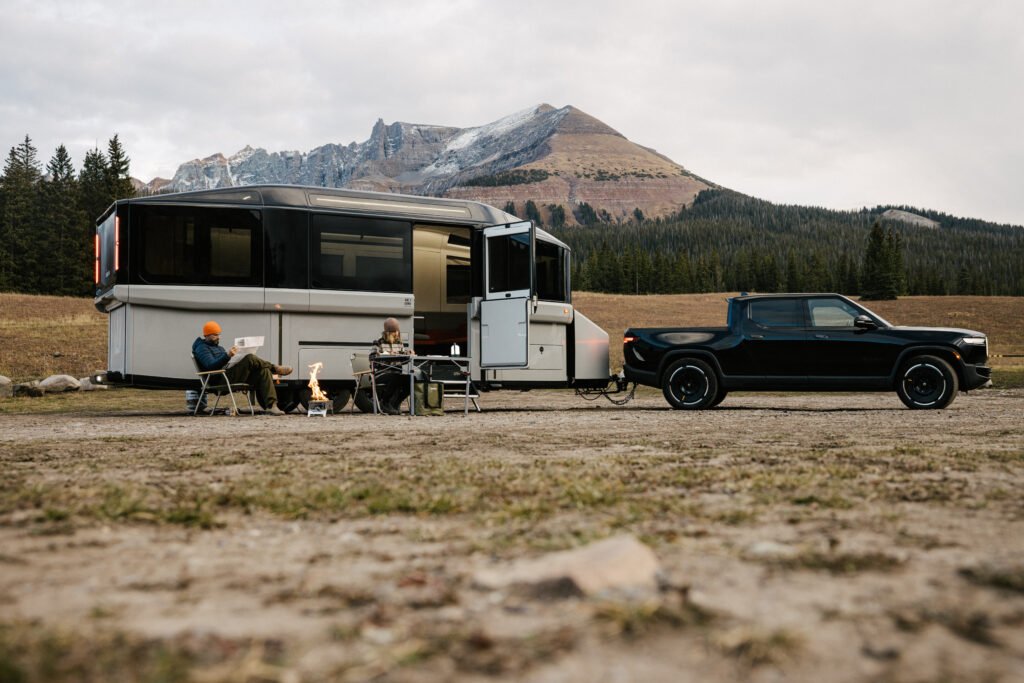
The most interesting engineering in the category
Most travel trailers are boxes. They push a wall of air down the highway and your fuel economy or your battery range pays for it. Lightship built the AE.1 around the opposite premise, which is that if you solve aerodynamics first, everything else gets easier.
The trailer travels at 6 feet 11 inches tall in Road Mode, which is shorter than a lot of the SUVs towing it, and then raises its roof to 10 feet 1 inch in Camp Mode for full standing height inside. That is a genuinely clever answer to a genuine problem, and it is the best idea anyone in this segment has had.
The catch arrives at checkout.
Lightship AE.1 – the quick answer
The Lightship AE.1 starts at $157,500 with a 7,150-pound dry weight, an 8,400-pound GVWR, and 1,250 pounds of cargo capacity. It has the largest battery in the category at 77 kilowatt-hours, the fastest charging by a wide margin at up to 155 kilowatts over NACS, and the most ground clearance at 12 inches.
The base trailer does not include the self-propulsion system. TrekDrive is a $20,000 option, which means the trailer that competes with a $139,500 Pebble Flow Magic Pack actually costs $177,500. A realistic family build lands closer to $206,500, and a fully optioned one has been priced out around $239,000.
Lightship also does not publish tongue weight on its current specification page. For a trailer in this weight class that number is not a detail, and its absence should shape how you approach the purchase.
Before you order, verify the numbers. Tongue weight and towing capacity vary by trailer configuration, options, and cargo, and by the exact year, make, model, trim, drivetrain, and equipment package of your tow vehicle. Two versions of the same truck can carry meaningfully different payload ratings. Confirm the trailer’s loaded tongue weight with the manufacturer for the specific build you are ordering, and confirm your vehicle’s tow rating and payload against the certification label on the driver’s door jamb and the owner’s manual. Weigh the loaded rig at a certified scale before a long trip.
The weight picture, including the number that is missing
The AE.1 lists a 7,150-pound dry weight against an 8,400-pound GVWR, which leaves 1,250 pounds of cargo capacity. That is the most generous cargo allowance among the pure-electric trailers, and it needs to be, because of what happens next.
The fresh water tank holds 50 gallons. Water weighs 8.34 pounds per gallon, so a full tank consumes 417 pounds. That takes you from 1,250 pounds of capacity down to roughly 833 pounds before a single duffel bag goes in the door.
Now start adding options. TrekDrive puts an electric drive module on the rear axle. The Elevated Living package adds a drawer dishwasher and a multi-stage water filtration system. Solar+ triples the rooftop array. Summit Sleeper mounts a bed to the ceiling. Every one of those adds weight, and none of them raise the GVWR, because the GVWR is a fixed structural rating. Options do not increase what the trailer can carry. They consume what it can carry.
Lightship does not publish the individual weight of its option packages, and it does not publish tongue weight on the current specification page. An earlier version of the trailer, the AE.1 Cosmos, carried a stated 820-pound tongue weight against a 7,450-pound dry weight, which works out to roughly eleven percent. Applying that same ratio to a loaded AE.1 near its 8,400-pound ceiling suggests something in the neighborhood of 925 pounds on the ball.
I want to be precise about what that last number is. It is my estimate, derived from a superseded specification and a standard ratio. It is NOT a Lightship figure, and you should NOT order a tow vehicle based on it.
What it does tell you is the order of magnitude you are dealing with, which is somewhere close to a thousand pounds of payload gone before your family gets in the car. Ask Lightship directly for the tongue weight of your exact configuration and get the answer in writing.
The charging story, which is the best in the category
This is where the AE.1 pulls ahead decisively. The 77-kilowatt-hour battery is the largest of the four trailers. It charges over NACS at up to 155 kilowatts with Lightship citing a one-hour charge at that rate.
Compare that to the Pebble Flow, which tops out at 44 kilowatts over CCS1 and has no native Supercharger access yet. If your travel involves long highway days and you want the trailer charging alongside the tow vehicle at the same stop, the AE.1 is one that does it without a workaround. That is a meaningful practical advantage that does not show up in a features list.
The base solar array is 670 watts. Solar+ raises it to 1.8 kilowatts for $10,000, which is the largest rooftop array in the segment. Home backup power runs at 10 kilowatts, and it comes standard (full vehicle-to-home capability will be added through a future software update).
Living in it as a family of four
The interior measures 22 feet 7 inches long and 7 feet 4 inches wide, with 7 feet 5 inches of headroom once the canopy is raised. Lightship rates sleep capacity at up to four adults comfortably.
More importantly, we now know how those four people actually sleep. The Switchback Lounge at the front unfolds into an approximately queen-size primary sleeping space. The dinette drops down and converts into a second sleeping space.
A Lightship representative demonstrating the AE.1 at the 2026 Florida RV Super Show confirmed that this standard configuration sleeps four on a Traveling with Robert video. But, I’m still having difficulty seeing where the fourth person sleeps without the Summit Sleeper. The optional Summit Sleeper adds a fifth berth rather than being necessary to get the trailer to four-person capacity per the Lightship rep.
That makes the standard layout more workable for a family of four than I initially thought, although there is still a tradeoff. The interior is essentially one large room. MotorTrend spent the night in an AE.1 with two adults and a five-year-old and came away generally positive about the space, but the reviewer specifically pointed out that four adults or a family with older children would have very little privacy. There is no separate bedroom, and there is currently no partition dividing the sleeping spaces.
Other interior thoughts
The windows wrap 270 degrees using a combination of shatter-resistant polycarbonate and automotive safety glass, with privacy shades on the large panes and bug screens on the windows that open. The enormous amount of glass makes the trailer feel much larger and more open than its dimensions suggest, but there is a downside. MotorTrend found that the interior gets very bright early in the morning. If you or your children need a genuinely dark room to sleep late, that is something to which I would pay attention during an in-person tour.
The collapsing upper section creates another compromise. Because those walls have to lower into Road Mode, there is less room for upper cabinetry, shelves, and the sort of storage or personalization you find in a conventional RV. MotorTrend specifically noted the lack of upper-wall storage after actually living in the trailer overnight. The paranoid person in me wonders what does prevent the top from coming down accidentally when someone is inside the camper.
The bathroom uses a layout where the shower, sink, and toilet share space, and you can either leave it open to rinse off kids and a dog or close off the sink and toilet to keep them dry. It is unusually spacious for a travel trailer.
Climate control comes from an integrated split heat pump rated at 20,000 BTU and 500 CFM, routed through a wraparound seat-back vent. That is the largest climate system in the group by a comfortable margin.
The optional Summit Sleeper is a ceiling-mounted twin measuring 78 by 39 inches with a 300-pound capacity, lowered from the tablet, with a tuckaway ladder. It costs $10,000 and expands sleeping capacity from four to five. For a family of four, that makes it a convenience option rather than a requirement.
The option pricing, laid out
The base AE.1 at $157,500 includes the 77-kilowatt-hour battery, 670 watts of solar, powered stabilizers, a rear camera, and home backup. Here is what everything else costs.
- TrekDrive self-propulsion: $20,000
- Elevated Living package, which adds a dishwasher, water filtration, a four-layer memory foam mattress, and induction cookware: $12,500
- Solar+, raising the array from 670 watts to 1.8 kilowatts: $10,000
- Summit Sleeper ceiling bed, adding a fifth sleeping space: $10,000
- Effortless package, which adds auto leveling, a 10-foot motorized awning, and a deployable 2,000-lumen exterior light: $9,000
- Non-standard exterior color: $5,000
- Non-standard interior color: $5,000
- Trailer Valet RVR9 remote maneuvering unit: $3,250
- 4K projector with 80-inch retractable screen: $1,500
- Spare wheel and tire: $500
A build with TrekDrive, the Effortless package, and Solar+ reaches $196,500 before tax, title, and registration. Adding the Summit Sleeper brings it to $206,500, although a family of four does not need that option simply to have enough sleeping capacity. Adding Elevated Living and both premium colors to that five-person configuration brings it to $229,000.
The ordering terms differ from the rest of the category as well. Lightship takes a $500 non-refundable order fee, followed by a $20,000 production deposit due 90 days before your delivery window, with the balance due the week the trailer arrives. Pebble takes a fully refundable $500 deposit and Evotrex takes a fully refundable $100. Lightship quotes roughly six months from order to delivery.
Build, service, and the company behind it
Lightship builds the AE.1 in Broomfield, Colorado. The company operated a 32,000-square-foot factory and announced an expansion in April 2026 that adds 44,000 square feet for a total near 76,000, targeting more than four times its previous annual capacity, with completion expected later in 2026. That expansion matters, because production capacity has been the constraint that separates a working startup from a stalled one in this segment.
The warranty runs three years on general components with an unlimited-mileage five-year warranty on the battery and drive unit. Service includes remote diagnostics through onboard telematics, with a mobile team dispatched typically within 36 hours when a problem cannot be solved remotely. There is no dealer network, which is either a feature or a liability depending on how far you live from anywhere.
One other limitation is worth knowing before treating the AE.1 as an all-weather adventure trailer. Lightship itself does not currently market it as a four-season RV. A company representative explained that the trailer has protected systems and active battery temperature management, but Lightship has not yet done enough extreme-cold testing to make a four-season claim.
What works and what does not
What works
- Road Mode height of 6 feet 11 inches makes this the most aerodynamic trailer in the category, and that shows up directly in tow vehicle range.
- Charging at up to 155 kilowatts over NACS is roughly three and a half times faster than the nearest pure-electric competitor.
- The 77-kilowatt-hour battery is the largest here, and 10-kilowatt home backup comes standard (pending a future software update).
- Twelve inches of ground clearance leads the group.
- The 20,000 BTU heat pump is the strongest climate system among these trailers.
- Cargo capacity of 1,250 pounds is the most generous of the pure-electric options.
- The standard interior configuration really does sleep four, with the optional Summit Sleeper increasing capacity to five.
- The company is expanding production capacity rather than contracting it.
What does not
- TrekDrive costs $20,000 and is not included, so the base trailer is 7,150 pounds of dead weight behind your vehicle.
- Tongue weight does not appear on the current specification page, which is the single most important number for anyone shopping a tow vehicle.
- The interior is essentially one large room, which means very little privacy for a family with older children or multiple adults.
- The large amount of glass makes the trailer bright early in the morning, which may matter to light-sensitive sleepers.
- The collapsing upper walls limit upper cabinetry, storage, and opportunities to personalize the interior.
- Lightship does not currently market the AE.1 as a four-season trailer because extreme-cold testing is still limited.
- The 9-degree departure angle is the shallowest in this group despite the tall ground clearance.
- The $500 order fee is non-refundable and the $20,000 production deposit comes due 90 days out.
- A realistically equipped four-person build with TrekDrive, Solar+, and the Effortless package reaches roughly $196,500 before tax, title, and registration.
Who should buy it
Buy the AE.1 if long highway days are your normal pattern and charging speed is the constraint you feel most, because nothing else here charges at 155 kilowatts. Buy it if you are towing with a full-size electric pickup where the aerodynamic advantage translates into real additional miles between stops. Buy it if you want the largest battery and the strongest climate system and you have the budget to option it properly.
For a family of four, the standard sleeping configuration supposedly works without buying the Summit Sleeper. Whether it works as your children get older is a different question. If everyone needs privacy and separate space, one large open room may become the bigger limitation than the number of beds.
If you buy one, buy TrekDrive. A Lightship without it gives up the reason to choose a Lightship.
Who should skip it
Skip it if your budget stops below $180,000, because a base AE.1 at $157,500 without TrekDrive gives up one of the major reasons to buy the trailer in the first place. Skip it if you cannot get a written tongue weight for your configuration before you commit, since the production deposit is substantial and the trailer is heavy. Skip it if your tow vehicle’s payload is anywhere near marginal, because a trailer this size loaded to its ceiling will ask for close to a thousand pounds of it. Skip it if your family needs separate bedrooms or real nighttime privacy, or if your travel plans depend on a proven four-season RV for sustained extreme-cold use.
Where to go next
Lightship sells direct with no dealer network, and the configurator lets you save a build and return to it. The company also runs a traveling roadshow, which is probably the best way to decide whether the open interior layout works for your family before you order.
See the AE.1 on Lightship’s website
Read Lightship’s full AE.1 specifications
Find a Lightship roadshow event
Pricing, specifications, and availability change frequently in this segment. Confirm everything with the manufacturer before you order.