
The Trailer I Want Is Not the Trailer I Would Buy
I have now spent a considerable amount of time with the specifications for all three of these trailers. If you asked me which trailer I find most appealing on paper, the answer is the Evotrex PG5, and it is not close.
It generates its own power. It can charge my tow vehicle at 60 kilowatts in the middle of nowhere. It gives a family of four two actual queen beds instead of a converted dinette.
And I would still probably buy the Pebble Flow. Here is why, and here is how the three of them stack up against each other.
A Note on Which Trailer Versions I Am Comparing
I am comparing the top trim of each trailer, not the entry price. That is a deliberate choice and it reflects how people actually buy things at this level.
When you are already spending well over a hundred thousand dollars, the marginal twenty or thirty thousand for the fully equipped version stops feeling like a separate decision. You are not going to spend $140,000 and then spend the next five years wishing you had the solar and the awning.
Evotrex confirms this pattern in its own numbers. The company told TechCrunch that roughly 90 percent of its order book is for the fully loaded Premium trailer rather than the $119,990 base.
So this article compares the Pebble Flow Founders Edition, a realistically equipped Lightship AE.1, and the Evotrex PG5 Premium. The entry prices for each trailer appear in the table for reference, and I cover each trim ladder in the individual reviews.
The Electric Trailer Comparison at a Glance
| Specification | Pebble Flow | Lightship AE.1 | Evotrex PG5 Premium |
|---|---|---|---|
| Trim compared | Founders Edition | AE.1 loaded | PG5 Premium |
| Price as configured | $175,000 | $206,500 | $159,990 |
| Cheapest way in | $113,500 | $157,500 | $119,990 |
| Dry weight | 5,800 lbs | 7,150 lbs | 8,900 lbs |
| GVWR | 6,800 lbs | 8,400 lbs | 9,900 lbs |
| Cargo capacity | 1,000 lbs | 1,250 lbs | 1,000 lbs |
| Tongue weight | 680 lbs published | Not on current spec page | Not published |
| Battery | 45 kWh | 77 kWh | 43 kWh + generator |
| Total usable energy | 45 kWh | 77 kWh | 270+ kWh |
| Charging in | 44 kW CCS1 | 155 kW NACS | 6.6 kW AC only |
| Charging out to your EV | No | No | 60 kW RangeBoost |
| Length | 25 ft | 26 ft 7 in | 28 ft 8 in |
| Sleeps 4 how | Queen + 54 in dinette | Convertible spaces | Two 80×60 queens |
| Where it is built | Fremont, CA | Broomfield, CO | Mostly China, assembled CA |
| Units delivered | 100+ | Delivering now | Zero |
| Earliest delivery | Now | ~6 months | 2H 2027 |
Before you order any of these, verify the numbers. Tongue weight and towing capacity vary by trailer configuration, options, and cargo, and by the exact year, make, model, trim, drivetrain, and equipment package of your tow vehicle. Two versions of the same truck can carry meaningfully different payload ratings. Confirm the trailer’s loaded tongue weight with the manufacturer for the specific build you are ordering, and confirm your vehicle’s tow rating and payload against the certification label on the driver’s door jamb and the owner’s manual. Weigh the loaded rig at a certified scale before a long trip.
Why I Want the Evotrex PG5
It Solves the Actual Problem
Towing with an electric vehicle destroys your range. Every pure-electric trailer in this category addresses that by adding powered axles, which helps, and then the trailer itself needs charging too.
The Evotrex approach is different. Its RangeBoost system pushes energy back into your tow vehicle at up to 60 kilowatts, which is DC fast-charging speed, in a national forest with no infrastructure anywhere nearby.
Nothing else here does that. It converts the trailer from something that costs you range into something that gives you range.
It Sleeps a Family Properly
The PG5 gives you two beds that each measure 80 by 60 inches. The Pebble Flow puts two people on a 54-inch-wide convertible dinette that you rebuild every night.
If you have travelled with two kids for a week, you understand why this matters more than a spec sheet suggests.
It Has Absurd Amounts of Power
More than 270 kilowatt-hours of usable energy against 45 for the Pebble Flow and 77 for the Lightship. Seven days off grid without rationing anything.
The catch is that it makes that energy with a gasoline generator, along with several other details worth knowing. I covered all of it in my full Evotrex PG5 review.
My First Concern: The Tongue Weight Evotrex Does Not Publish
What the Situation Actually Is
Evotrex publishes a dry weight and a GVWR for both trims. It does not publish a tongue weight for either one.
Its FAQ directs buyers to their vehicle’s owner’s manual, and states that Evotrex does not provide advice on tow vehicle selection.
Why That Bothers Me
I want to be careful with my words here. I am not suggesting that Evotrex is concealing anything, and I have no basis on which to make that claim.
What I can say is this. A company that has published a dry weight of 8,900 pounds and a GVWR of 9,900 pounds, and that has a prototype it has been testing and displaying at trade shows, is in a position to weigh the tongue.
Tongue weight is not an obscure figure. It is the single number that determines whether a given vehicle can legally and safely tow a given trailer.
The Practical Effect
Leaving it unpublished shifts the verification burden onto the buyer. The buyer is the person in this transaction least equipped to carry it.
Using the standard industry ratio of eleven to thirteen percent, a PG5 Premium loaded to its ceiling likely places somewhere near 1,190 pounds on your hitch ball. That estimate is mine, not Evotrex’s, and I would not order a truck based on it.
But that is the problem. On a $159,990 purchase, a customer should not be reverse-engineering the most important specification from a percentage I found in a towing guide.
What I Would Do
The preorder deposit is $100 and fully refundable. Place it if you want, then ask Evotrex in writing for the loaded tongue weight of your exact configuration.
If you get a number, that resolves my concern entirely. If you cannot get one, that is information too.
My Second Concern: Where the PG5 Gets Built
The Facts
Evotrex founder Alex Xiao has told reporters that the company plans to manufacture most of the trailer in China and complete final assembly in California. He repeated that plan in June 2026 and said locations were still being finalized.
Evotrex is a California company based in the Los Angeles area, with roughly 40 employees split between China and the United States as of late 2025. I laid out the funding, the founding team, and the manufacturing plan in more detail in the PG5 review.
Why It Concerns Me, and Why It Is Not About Country
I own Anker products. I own Lenovo products. I am not telling anyone which countries to buy from, and that is not what this is about.
My concern is what happens on a Tuesday in 2029 when something breaks. On a six-figure first-generation product from a company that has never delivered one, the questions that matter are parts availability, warranty service, turnaround time, and supply chain continuity.
Xiao himself acknowledged to TechCrunch that United States trade policy could create challenges for that manufacturing plan. That is a candid answer, and I give him credit for it, but it does not make the risk go away.
The Contrast Is Instructive
Lightship does not merely keep a Colorado headquarters. It builds the AE.1 in Broomfield and expanded that factory in 2026.
Pebble builds the Pebble Flow in Fremont, California. When your trailer needs a part, the distance between you and the people who made it is not a philosophical question.
Why I Would Probably Buy the Pebble Flow
Reason One: They Have Actually Delivered
Pebble surpassed 100 Pebble Flow trailers delivered across the United States within its first year of production. That is the most important sentence in this entire article.
It means real owners have towed these, lived in them, found the problems, and complained publicly. It means a service process exists because it has been used.
Lightship is delivering as well and expanding its factory. Evotrex has delivered zero units and now shows an estimated production date in the second half of 2027.
Reason Two: The Tongue Weight Works
Pebble publishes 680 pounds. That figure is low enough that a large electric SUV enters the conversation rather than being ruled out immediately.
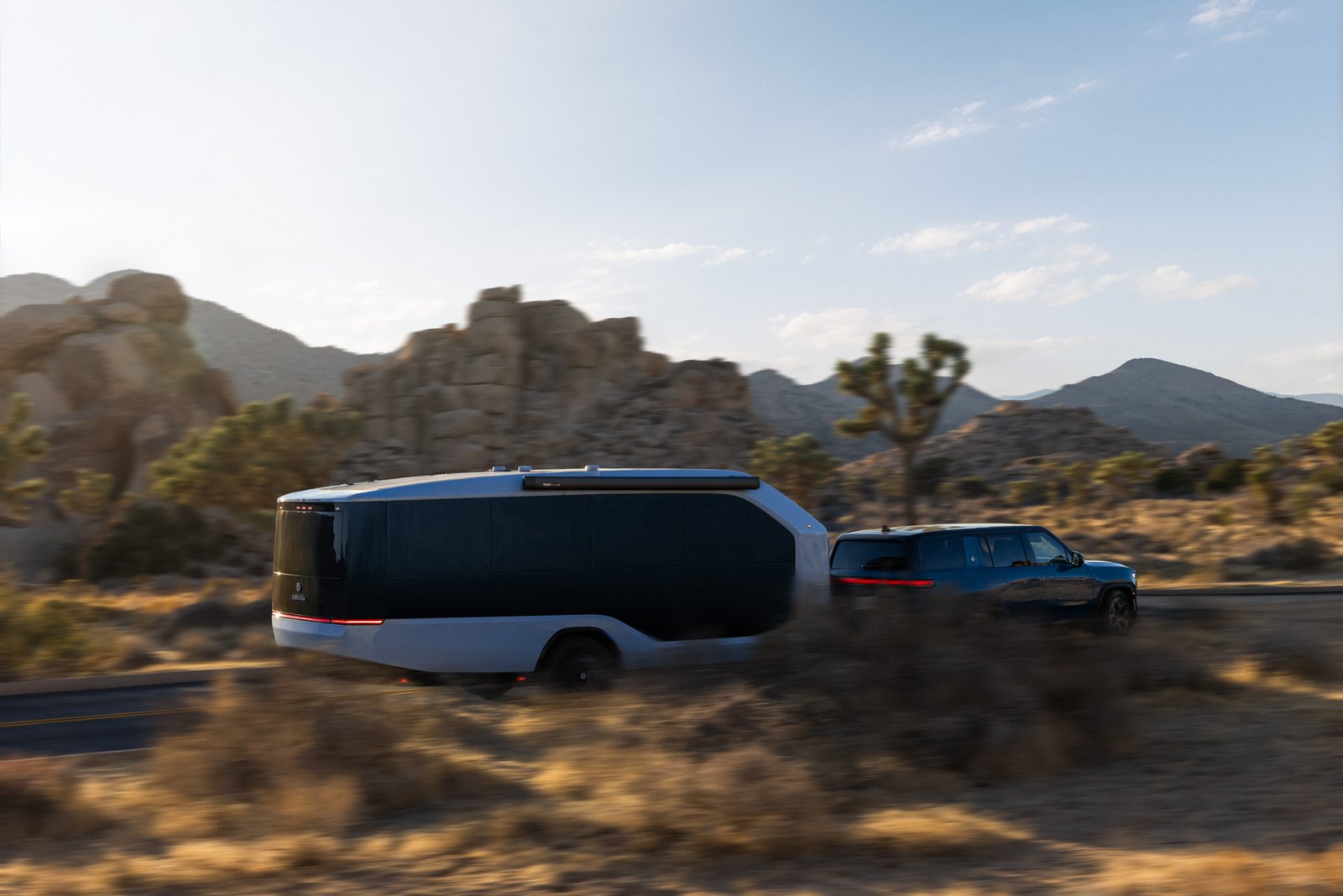
I own a Rivian R1S, and Pebble’s own gallery imagery shows a Pebble Flow behind an R1S. I am not going to pretend that settles the question, because tongue weight comes out of payload and payload varies by configuration and by how many people are in the car.
But it puts the Pebble Flow in a category the other two are not in. The Lightship and the Evotrex are, realistically, full-size pickup propositions.
Reason Three: Pebble States the Limits Out Loud
Pebble says directly that its Easy Tow system does not change the required GVWR or tongue weight limits, and that your tow vehicle must still meet the recommended rating.
After spending weeks in this category, I find that kind of statement genuinely reassuring. A company willing to tell you what its technology does not do is telling you something about how it will behave when you have a problem.
The trim structure matters here too, because the cheapest version drops the motors entirely. I worked through that in my full Pebble Flow review.
One Caveat About Buying the Founders Edition
Pebble publishes a single dry weight of 5,800 pounds and a single GVWR of 6,800 pounds across the lineup. The Founders Edition adds solar panels, all-terrain levelers, an awning, and exterior smart glass, and none of that equipment raises the GVWR.
Every pound of it comes out of your 1,000 pounds of cargo capacity instead. I have not seen a Founders-specific dry weight or tongue weight from Pebble, and I would ask for both before ordering.
This is the same trap the Evotrex PG5 Premium demonstrates more visibly, where the top trim weighs 550 pounds more while the GVWR rises only 400. Buying up costs you payload on all of these trailers.
What I Give Up
Charging. The Pebble Flow tops out at 44 kilowatts over CCS1 with no native Supercharger access yet, against 155 kilowatts over NACS for the Lightship.
Sleeping space. My two kids would share a 54-inch convertible dinette, and I would rebuild it every night of the trip.
Off-grid endurance. Forty-five kilowatt-hours is a fraction of what the Evotrex carries.
Where Lightship Fits
The Best Engineering Here
The AE.1 travels at 6 feet 11 inches tall and raises its roof to 10 feet 1 inch at camp. That is the smartest idea anyone in this category has had, and it pays off directly in tow vehicle range.
It also charges at 155 kilowatts over NACS, which is roughly three and a half times faster than the Pebble Flow. If you drive long highway days, that difference is real.
Why It Is Probably Too Heavy for Me
The AE.1 runs 7,150 pounds dry against an 8,400-pound GVWR. Lightship does not publish tongue weight on its current specification page, though a superseded version of the trailer listed 820 pounds.
Scaling that ratio to a loaded AE.1 suggests something near 925 pounds. That is a full-size truck conversation, not an SUV conversation.
The Price Problem
The base AE.1 costs $157,500 and does not include TrekDrive, the self-propulsion system, which is a $20,000 option. Adding it alone brings you to $177,500, which is already past the fully loaded Pebble Flow Founders Edition.
A realistic family build with TrekDrive, Solar+, the Effortless package, and the Summit Sleeper reaches roughly $206,500. Adding the Elevated Living package and premium colors takes it to about $229,000.
So the Lightship costs roughly $31,500 more than a Founders Edition Pebble Flow and about $46,500 more than an Evotrex PG5 Premium. I broke down every option and what it costs in my full Lightship AE.1 review.
How to Choose Between the Three
Choose the Pebble Flow If
You want the lightest trailer with a published tongue weight you can plan around. You want to buy from a company that has delivered more than 100 units and has a service process that has been tested by actual customers.
You want the trailer in your driveway this year rather than in 2027.
Choose the Lightship AE.1 If
You drive long highway days and charging speed is the constraint you feel most. You tow with a full-size pickup and the aerodynamic advantage translates into real additional miles.
You want a trailer built in Colorado by a company expanding its factory rather than contracting it. Budget for TrekDrive, because a Lightship without it gives up the reason to buy a Lightship.
Choose the Evotrex PG5 If
You want to camp genuinely off grid for a week and charge your tow vehicle from the trailer. You have a full-size electric pickup with the payload to handle roughly 1,200 pounds on the hitch.
You are comfortable waiting until at least the second half of 2027, and you have obtained a tongue weight figure in writing before your deposit converts into a purchase agreement.
The Verdict
On paper the Evotrex PG5 is the most interesting trailer in this category, and I would tell anyone that. It does things the others cannot do, and it does them for less money than a comparably equipped Lightship.
But buying a six-figure trailer is not a paper exercise. It is a bet on a company being there when something goes wrong, and on a number you can verify before you tow your family down a mountain.
Here is what makes that choice uncomfortable. Compared trim for trim, the Evotrex PG5 Premium is the cheapest of the three at $159,990, and the Pebble Flow Founders Edition costs $15,010 more.
I would pay that premium anyway. Pebble has delivered more than a hundred of these, builds them in California, publishes the number that matters, and states plainly what its technology will not do for you.
That $15,010 is not buying me features. It is buying me a trailer that exists, a tongue weight I can verify, and a company I can reach when something breaks. That is a less exciting story and a better purchase.
Ask me again in 2028. If Evotrex ships, publishes a tongue weight, and builds a service network, my answer changes.
Read the Full Reviews
Pebble Flow review: is this electric RV worth $140K?
Lightship AE.1 review: the aerodynamic trailer with a $20,000 asterisk
Evotrex PG5 review: what the $119,990 price really buys
Pricing, specifications, and availability change frequently in this segment. Confirm everything with the manufacturer before you order.