
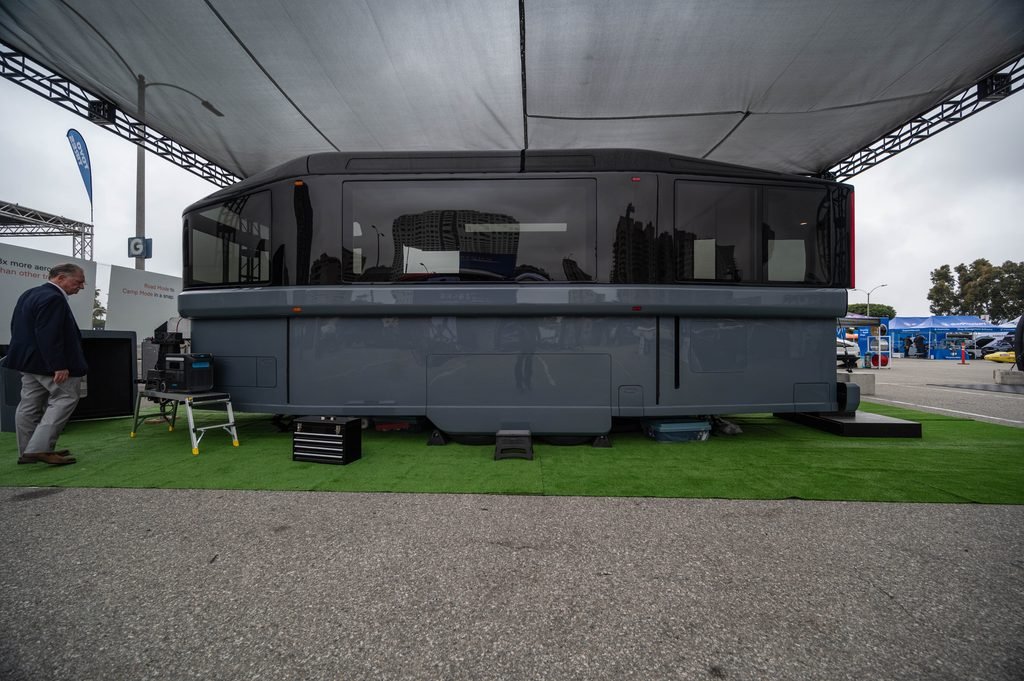
The cheapest electric RV you can get delivered today costs $157,500. A popular 25-foot conventional trailer lists for around $43,000. That gap buys a lot of campground fees. So what do you get for it?
A quick note on names. These are towable trailers with their own large batteries and motors. Makers and reviewers often call them electric travel trailers. Here I’ll call them electric RVs.
The Quick Answer
An electric RV is worth the premium for one kind of buyer: someone who tows with an EV, camps off grid and values automation. For everyone else, a good conventional trailer is the smarter buy. The fair comparison isn’t a budget trailer. It’s an Airstream. Against an Airstream, the gap shrinks a lot.
Electric RV Prices vs Conventional Trailers
| Trailer | Type | Price | Delivering now? |
|---|---|---|---|
| Average standard-hitch travel trailer (J.D. Power retail value, last 10 model years) | Conventional | $25,565 | Yes |
| Winnebago Thrive 25RLS (2026) | Conventional | ~$42,896 average listing | Yes |
| Airstream Flying Cloud 25FB (2026) | Conventional, premium | $121,900 to $132,300 MSRP | Yes |
| Aboard T4 | Electric with gas range extender | From $80,000 | No |
| Evotrex PG5 | Electric with gas generator | From $119,990 | No |
| Lightship AE.1 | Electric | From $157,500 | Yes |
| Pebble Flow Magic Pack | Electric | From $159,000 | Yes |
The J.D. Power figure includes used trailers, so treat it as a floor. Airstream prices vary by dealer and floorplan.
Two illustrative gaps tell the story. A Pebble Flow Magic Pack at $159,000 costs about $116,100 more than the average Thrive listing. Against a $121,900 Flying Cloud, the electric RV costs $37,100 more.
What the Electric RV Premium Buys
- Tow assist. Motors in the trailer push some of its weight. For an EV that’s the difference between a usable towing range and a frustrating one. One R1T owner reported his truck’s navigation treated a 6,500-pound Pebble Flow as about 5,000 pounds with tow assist on.
- A big battery. Pebble’s is 45 kWh. Lightship’s is 77 kWh. That runs heat, air conditioning and appliances off grid without a generator rumbling next door.
- Home backup. Pebble rates its trailer at up to 12 kW of output. In a hurricane-prone region that’s a second job for the purchase.
- Automation. Self-hitching, remote-control parking and one-tap leveling make the scariest parts of towing easy for beginners.
- No propane. Everything runs on electricity. There’s nothing to refill or service.
What an Electric RV Doesn’t Buy
- A track record. Pebble passed 100 deliveries in July 2026. Airstream has been building trailers for decades.
- A dealer network. Pebble and Lightship sell direct and send mobile technicians. That’s great near a service area and harder far from one.
- Easy charging. Many campgrounds restrict charging from RV pedestals. Only some fast chargers fit a trailer. My guide to electric trailer charging covers the details.
- More cargo. The Pebble Flow carries 900 pounds. A 2026 Flying Cloud 25FB dealer listing shows 1,797 pounds of cargo capacity.
Who Should Buy an Electric RV
Buy it if you already tow with an EV and towing range is your real problem. Buy it if you camp off grid often enough to use the battery. Buy it if you’re new to towing and the automation is what gets you out the door.
Skip it if you tow with a gas or diesel truck and camp at full-hookup sites. You’d be paying six figures for features you won’t use. Skip it if a conventional trailer plus a portable generator covers your trips.
Would I Buy an Electric RV?
If I’m buying a camper, yes. I don’t enjoy sleeping on the ground when we camp with our kids, so comfort wins. An electric RV is nicer and more modern inside. I’d almost certainly pick one over a conventional trailer.
The harder question is whether to buy a camper at all. A well-equipped electric RV gets close to $200,000. My rough estimate is that a week somewhere nice for our family runs under $25,000, maybe under $20,000, even flying United Premium Plus and staying at a nice hotel. That’s about eight vacations for the price of the trailer. The electric RV wins only if you’ll camp and road trip a lot.
If you’re leaning electric, my comparison of the electric trailers breaks down which one fits which buyer.
So, Is It Worth It?
Against a mainstream trailer, an electric RV is a luxury purchase. Against an Airstream, it’s a closer call than the sticker suggests. The premium pays off only if you’ll use the battery, the motors and the automation. Otherwise it’s a very expensive way to avoid buying propane.
Sources
- J.D. Power: 2026 Q1 Recreational Vehicle Market Report
- RVs on Autotrader: 2026 Winnebago Thrive 25RLS pricing
- J.D. Power: 2026 Airstream Flying Cloud 25FB pricing
- Blue Compass RV: 2026 Airstream Flying Cloud 25FB listing
- RV Universe: 2026 Airstream Flying Cloud 25FB cargo capacity
- PR Newswire: Aboard completes Pre-Series A funding
- Evotrex: PG5 preorder
- Lightship: Build your AE.1
- Pebble: Order a Pebble Flow
- Pebble: Pebble Flow technical specs
- The EV Report: Pebble Flow passes 100 deliveries
- Torque News: Rivian R1T owner towed the Pebble Flow
This article is for general informational and entertainment purposes only. It is not legal, medical, financial, tax or other professional advice, and reading it does not create a professional relationship of any kind. Information may be incomplete or may change after publication. Opinions are the author’s own. Consult a qualified professional about your specific situation. Prices and promotions were accurate at the time of publication and change frequently.