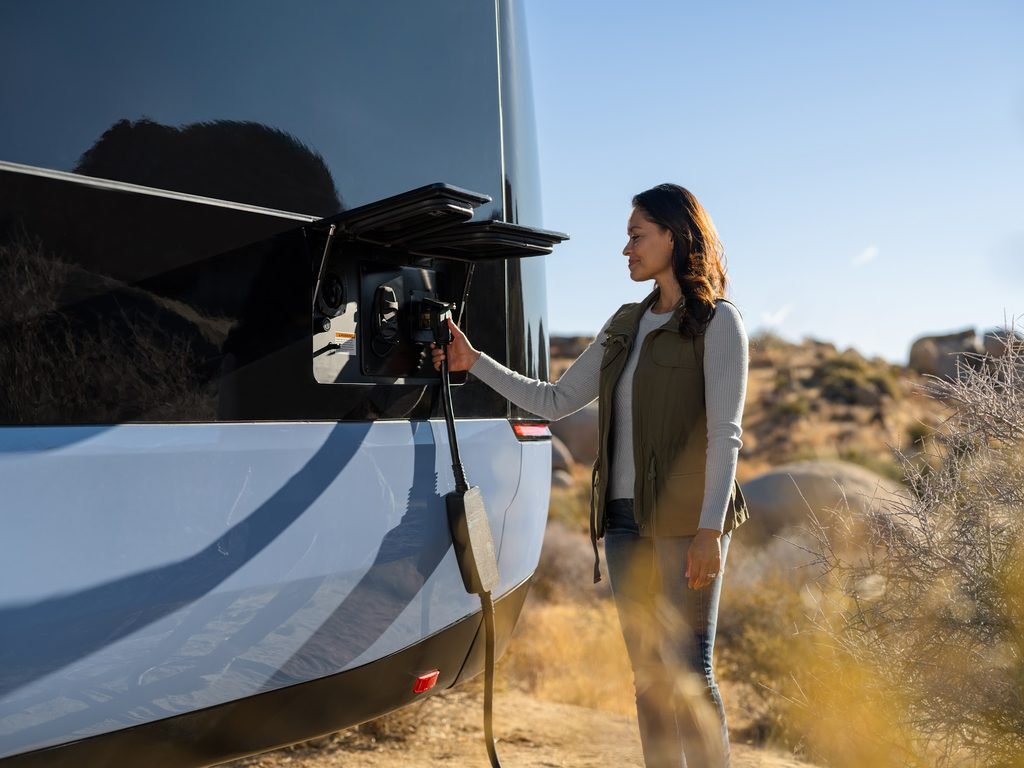
Electric trailer charging looks easy in the ads. A sleek trailer sits at a quiet campsite, plugged into the pedestal. Real trips, however, look different.
For example, picture pulling into a fast charger with 40-plus feet of SUV and trailer. The stall was built for a compact car. Charging is the biggest open question for electric trailers. Here’s what works today.
The Quick Answer
You have two places for electric trailer charging: campground hookups and public fast chargers. Campgrounds are slow and don’t always allow it. Fast chargers are quick. However, only some fit a trailer.
No single app answers both questions yet. Where can I charge? Will my rig fit? So you’ll need your vehicle’s trip planner plus a second tool to check the stall layout.
How Each Trailer Handles Electric Trailer Charging
The trailers don’t charge the same way. As a result, that difference decides where you can stop.
| Trailer | Fast charging into the trailer | AC charging | Status |
|---|---|---|---|
| Pebble Flow | CCS1 (no native Supercharger access yet) | Up to 6.6 kW | Delivering |
| Lightship AE.1 | NACS, up to 155 kW | Not published | Delivering |
| Evotrex PG5 | None | Up to 6.6 kW | Not yet delivering |
| Aboard T4 | NACS (rate not published) | Yes (rate not published) | Not yet delivering |
A trailer with DC fast charging can top up at the same stop as your tow vehicle. One without it charges at a campground or makes its own power instead. Because of this, the Evotrex and the Aboard both carry gas range extenders.
For full specs, see my guides to the Pebble Flow, the Lightship AE.1 and the Evotrex PG5.
Campground Charging: Ask Before You Plug In
A 50-amp RV pedestal can physically handle electric trailer charging. However, whether you’re allowed to is another matter.
KOA’s guidance says a 50-amp socket can technically charge an EV. Even so, the company doesn’t condone it. Instead, it tells campers to check with each campground first.
Several KOA site listings also say flatly that EV charging isn’t allowed. Similarly, Death Valley’s Furnace Creek campground posts the same message on its pedestals.
Operators have practical reasons. A June 2026 Camp and Charge Report surveyed 504 campgrounds. More than half of the operators who restrict charging do so because they want to protect their equipment from long, high-amp draws. As a result, some parks now charge a fee instead of banning it.
An electric trailer complicates the conversation. It’s an RV with a car-sized battery. So when you call, ask two questions. May the trailer charge its main battery from the pedestal? Is there a fee?
Even when it’s allowed, it’s slow. Here’s an illustrative example. A 45-kWh battery at 6.6 kW needs roughly seven hours from empty, before charging losses. That’s fine overnight. As a quick stop, however, it’s useless.
Fast Chargers: Will Your Rig Fit?
First, start with length. A Pebble Flow is 24 feet 8 inches long. Add a Rivian R1S at about 16.7 feet. Hitched together, that’s roughly 41 feet before you count the hitch.
Most fast-charging stalls are nose-in parking spaces. With a trailer attached, you either block several spaces or unhitch elsewhere in the lot. Pull-through stalls make electric trailer charging much easier. Fortunately, some networks are building them.
- Tesla Superchargers: Tesla now marks trailer-friendly sites. In Trailer Mode they rise to the top of the charging list. The company also adds trailer stalls when it can do so at reasonable cost.
- Rivian Adventure Network: The network’s head told AFAR that 70 percent of its sites are trailer friendly. Many sites are open to other EVs too.
- IONNA: In April 2025, 16 of its 120 stalls were pull-through. Since then, the network has grown past 180 sites.
- Pilot and Flying J with GM and EVgo: Many of these travel centers have canopies plus pull-through stalls for drivers who tow.
Tesla’s trailer stalls carry a sign: “Priority for Trailers, Please Use Last.” Not towing? Then that sign is talking to you.
Not sure your EV can pull the weight? My guide to EV tow vehicles covers which ones can actually tow an electric trailer.
Is There an App for Electric Trailer Charging?
Not one that does everything. Some apps plan range with a trailer. A few flag trailer-friendly stalls. However, none I found does both across every network.
| Tool | Flags trailer-friendly chargers? | Plans range with a trailer? | Best for |
|---|---|---|---|
| Tesla in-car navigation | Yes, Superchargers only | Yes, in Trailer Mode | Tesla drivers |
| Rivian app and navigation | Rivian has said it marks trailer pull-through sites | Yes, with a trailer profile | Rivian drivers |
| PlugShare | No trailer filter in its published filter guide; photos and user notes help | No | Scouting a specific stop |
| A Better Routeplanner (ABRP) | No; users have requested a pull-through filter | Yes, with custom consumption settings | Planning across networks |
| Ford and GM in-vehicle tools | No | Ford’s trip planner has a Tow and Haul option. GM’s trailer navigation routes around low or narrow bridges. | Route fit, not charger fit |
The practical combo is your vehicle’s planner for range plus PlugShare photos for each stop. Owners on enthusiast forums also describe the same workaround. It’s clunky, but it works.
A Simple Electric Trailer Charging Plan
- First, plan the route in your vehicle’s navigation with trailer mode or a trailer profile turned on.
- Next, open each planned stop in PlugShare. Check the photos for pull-through lanes and the lot layout.
- Favor networks that build for trailers: Tesla trailer stalls, Rivian sites, Pilot and Flying J or IONNA pull-throughs.
- Call each campground. Ask whether the trailer may charge from the pedestal and what it costs.
- Finally, arrive at every charger with a buffer. Know where you’d unhitch if the pull-through is taken.
Still choosing a trailer? Weigh charging as heavily as price. My comparison of the electric trailers lays out each one’s charging specs.
Wondering whether one is worth the money at all? Read Electric RV vs a Regular Trailer.
The Bottom Line
Electric trailer charging works when you plan it. On the other hand, it fails when you expect a gas-station experience. Until one app shows every pull-through stall, a trip planner and a call to the campground belong on your gear list.
Sources
- Pebble: Pebble Flow technical specs
- Lightship: AE.1 specifications
- Evotrex: FAQ and specifications
- New Atlas: Aboard T4 travel trailer
- KOA: How electric vehicles will change the way you camp
- RV Travel: EV charging prohibited at 50-amp campsite pedestal
- Modern Campground: Camp and Charge Report, June 2026
- InsideEVs: It’s now easier to find trailer-friendly Tesla Superchargers
- AFAR: Towing with an EV on the Rivian Adventure Network
- EVChargingStations.com: IONNA expands to 12 sites
- Electrek: IONNA tops 180 charging sites
- EVgo: Pilot, GM and EVgo open over 200 locations
- PlugShare: Guide to map filters
- ABRP: Feature request for a pull-through filter
- Ford: Plan a trip with the Tow and Haul option
- Chevrolet: Trailer route planning guide
- Kelley Blue Book: 2026 Rivian R1S Tri specs
This article is for general informational and entertainment purposes only. It is not legal, medical, financial, tax or other professional advice, and reading it does not create a professional relationship of any kind. Information may be incomplete or may change after publication. Opinions are the author’s own. Consult a qualified professional about your specific situation. Specifications are drawn from manufacturer product pages.